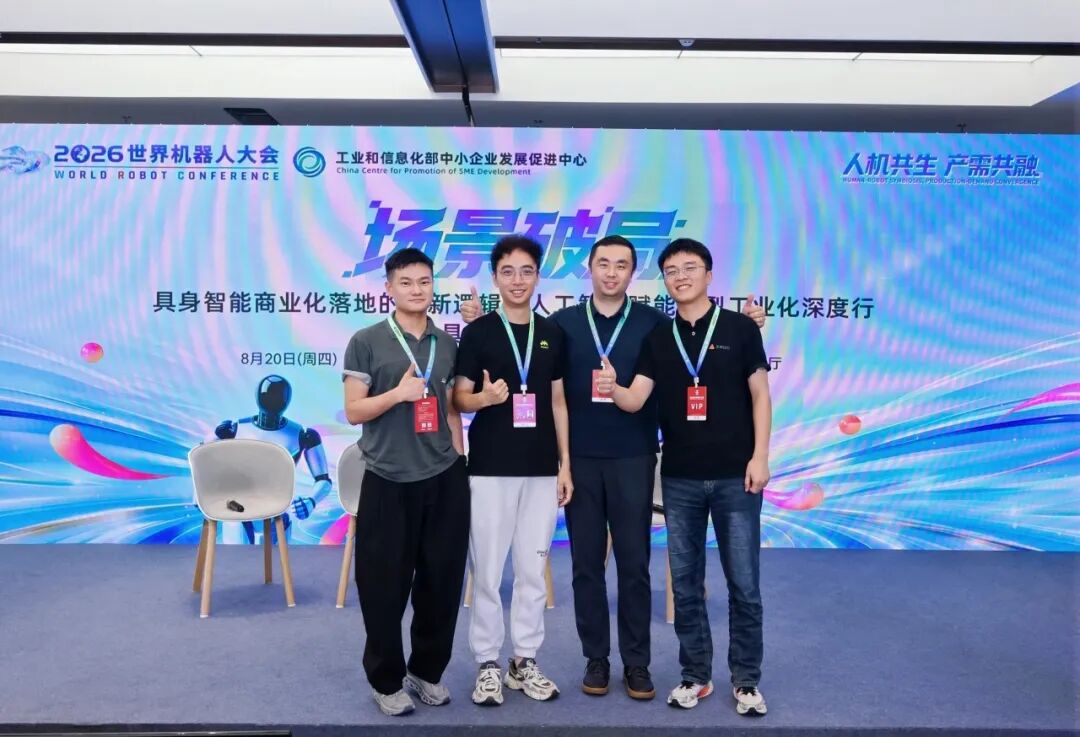
WRC Live | From Technological Singularity to Industrial Singularity – A Candid Discussion Among Three Embodied Intelligence Founders
"It is like a yet-unshaped chaos, yet brimming with life everywhere."
On August 20, at the 2026 World Robot Conference (WRC), a candid discussion on embodied intelligence took place among frontline founders at the forum "Innovative Logic of Embodied Intelligence Commercialization," hosted by the China Centre for Promotion of SME Development under the Ministry of Industry and Information Technology.
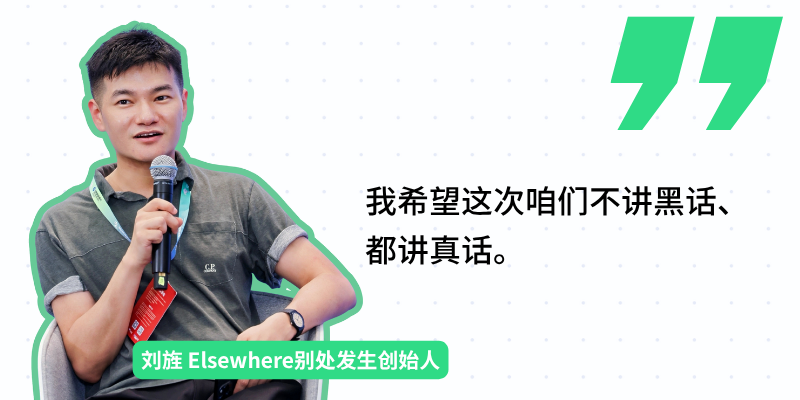
The roundtable, titled "From Technological Singularity to Industrial Singularity: The Dual Threshold of Embodied Intelligence," featured three guests, all emerging players in embodied intelligence backed by HyT Capital: Huang Qingqiu, Co-founder and CTO of Mochi Intelligence; Xia Zhongpu, Co-founder and CTO of Anyverse Dynamics; and Lang Xianpeng, Co-founder and CTO of Kunlunx AI. The roundtable was moderated by Liu Jing, Founder of Elsewhere.
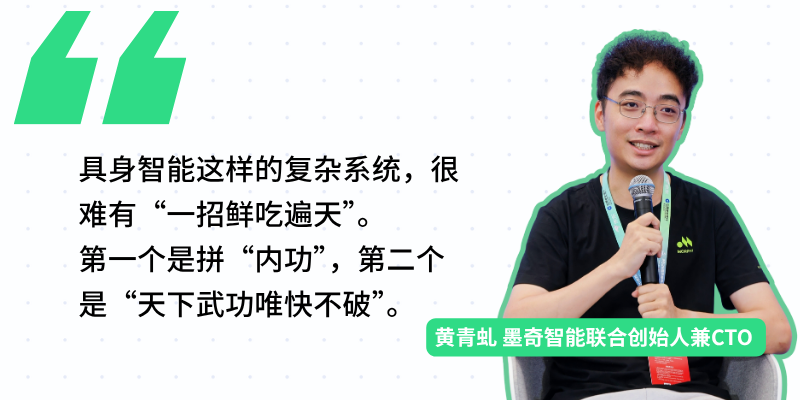
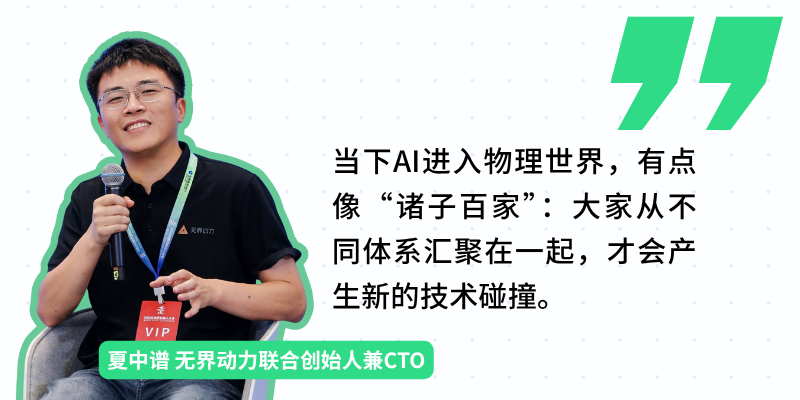
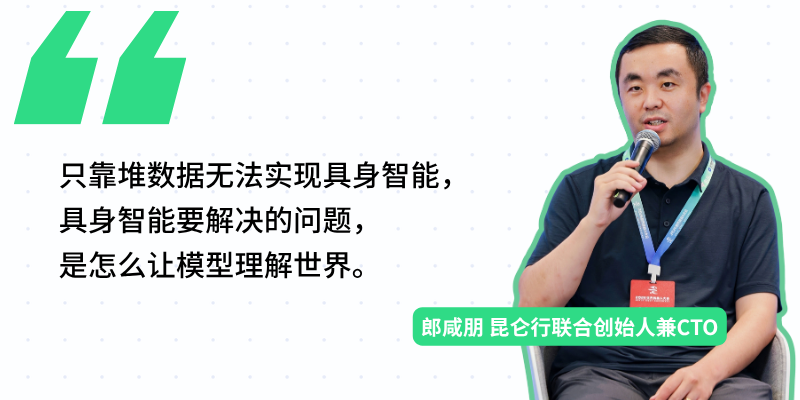
The following is a curated transcript of the roundtable discussion, edited and published.
01 After Starting Up: The Real Feelings Behind the "Hype"
Liu Jing: There are now many entrepreneurs in the embodied intelligence space. Some of you may have been colleagues before, and today you are all founders. I hope we can all speak frankly today. Please start by briefly introducing yourselves.
Xia Zhongpu: I'm Xia Zhongpu, Co-founder and CTO of Anyverse Dynamics. In my early career, I worked on decision planning and AI at Baidu Apollo, and was among the earliest practitioners in autonomous driving in China. Later, I joined Li Auto, where I completed the mass production of China's first-generation end-to-end autonomous driving system.
Lang Xianpeng: I'm Lang Xianpeng, Co-founder and CTO of Kunlunx AI. Previously at Li Auto, I built the data closed-loop infrastructure for 1.5 million vehicles, and witnessed the paradigm shift from rule-driven to data-driven incremental iteration. Now in embodied intelligence, I hope to push embodied AI systems from imitation learning toward a new paradigm of understanding the world.
Huang Qingqiu: I'm Huang Qingqiu, Co-founder and CTO of Mochi Intelligence. Our core mission is to bring embodied intelligence into real life. Before this, I was in charge of AI algorithms for autonomous driving at Huawei. Today, I'm here to speak frankly with everyone.
Liu Jing: Can you share how you feel about starting your own company?
Huang Qingqiu: The first feeling is "hype." This industry is even more hyped than I expected — people from all kinds of backgrounds are coming in, and the level of attention is very high.
The upside of the hype is that it gives us access to more resources, and funding is one of the foundations for getting things done. The challenge is that there is a lot of noise. How to extract truly useful information from it is a major test.
Another feeling is that we set out to build robots that could help us with work, but the reality is that every day we are either solving problems or on our way to solving problems — from hardware, software, to algorithms and data, the range of product issues we touch is enormous.
Lang Xianpeng: Kunlunx AI was registered in mid-March this year. The biggest feeling over these six months is "déjà vu."
The whole industry feels a lot like new energy vehicles and autonomous driving ten years ago. I feel like I've returned to the time when I first joined Li Auto — somewhat familiar, yet not quite the same.
What's familiar is the state of being a founder. What's different is that AI iteration is incredibly fast. Facing embodied intelligence requires a different approach.
Xia Zhongpu: I also feel like I've gone back ten years. But the biggest difference this time is the rapid upgrade in cognition.
When I first started working on autonomous driving ten years ago, we thought no system was more complex than it — because it required prediction, with many modular algorithms mixed together and the need to orchestrate the entire system. Later, after we transitioned to end-to-end, the overall intelligent system became simpler — a single-model system.
Now that I'm in the embodied intelligence space, the "blank slate" we face is much larger than in autonomous driving. Autonomous driving may only require one model, but in embodied intelligence, the scenarios and data are almost entirely uncharted. How to plant the seed and let it grow into a towering tree — that's what we've been exploring.
02 Describing Your Company's "Killer Feature" in Plain Language
Liu Jing: I've seen a rather staggering statistic — the number of companies in the embodied intelligence space is enormous. In language we can all understand, what exactly is your "killer feature"?
Huang Qingqiu: In an industry like embodied intelligence, where systems are highly complex, it's hard to have a one-size-fits-all silver bullet. I think it comes down to "inner strength" — especially in the early stages of the industry. We need to improve the stability, mass-producibility, reliability of the hardware, and the stability of the underlying architecture.
Second, "speed is the ultimate weapon." In the early stages of an industry, fast trial and error is extremely important. We spent eight months building a complete data-algorithm system — a rare example of rapid iteration in this space.
Lang Xianpeng: For me, the biggest advantage is that I've actually gone through the entire 0-to-1 startup phase.
This 0-to-1 is not about lab experiments or building a new feature inside a large company — it's about facing real business competition and real user pressure. At Li Auto, I participated in building autonomous driving from 0 to 1. That involved technology, infrastructure, capabilities, and more — a true test of a founder's ability in forward-looking judgment and strategic execution.
Embodied intelligence is at an even earlier stage than autonomous driving was. Autonomous driving was already difficult under the precondition that the automotive industry had developed for nearly 100 years, let alone embodied intelligence, which faces massive challenges in hardware, models, data, and scenarios. Past success does not guarantee future success — we must iterate quickly.
Xia Zhongpu: What we think about most is: what is the problem? And where is the endgame?
People often talk about "first principles." But what exactly is the first principle of robotics? What is the endgame? What is the path? I think the key is to find the starting point and the end point. If the problem is the starting point and the endgame is the end point, with these two points, the solution and the path are determined.
We chose not to just build lab-level demos, but to deploy in industrial and commercial scenarios. In real deployment, we seek the root causes of the problem and the endgame.
Everyone's cognition is different. "First principles" are built on one's own cognition; judgments about the "endgame" are also based on one's own cognitive framework. So the hardest part is breaking through one's own cognition. Whether the founding team's cognition can iterate quickly, understand where the endgame is heading, and find the shortest path — that will be the key to success in embodied intelligence.
People often talk about "first principles." But what exactly is the first principle of robotics? What is the endgame? What is the path? I think the key is to find the starting point and the end point. If the problem is the starting point and the endgame is the end point, with these two points, the solution and the path are determined.
We chose not to just build lab-level demos, but to deploy in industrial and commercial scenarios. In real deployment, we seek the root causes of the problem and the endgame.
Everyone's cognition is different. "First principles" are built on one's own cognition; judgments about the "endgame" are also based on one's own cognitive framework. So the hardest part is breaking through one's own cognition. Whether the founding team's cognition can iterate quickly, understand where the endgame is heading, and find the shortest path — that will be the key to success in embodied intelligence.
03 Why There Is No "Common Language" in Embodied Intelligence
Liu Jing: I've looked into the embodied intelligence space, and one thing I've noticed is that everyone seems to have their own language. Why is there such a strong divergence in terminology and framing in this industry?
Huang Qingqiu: Probably because the industry brings together people from very different backgrounds. There are those who work on large models, those who came from autonomous driving, those who worked on traditional robotic arms... Their language and domain knowledge differ, so naturally they describe things differently.
Embodied intelligence is different from virtual-world applications. For large language models, for example, there are relatively unified application scenarios, so standards can be established. But embodied intelligence is still technologically immature, and the requirements and evaluation criteria differ across scenarios.
More importantly, it involves hardware, which makes it difficult to form unified standards through virtual testing metrics alone. So people end up describing their understanding at different levels.
Lang Xianpeng: I think this shows that the industry is still in its early stages.
From innovation to maturity, and then to large-scale deployment, a technology typically goes through at least three phases.
The first is the technology innovation phase — which is where we are now, with hardware, models, and supply chains still evolving.
The second is the commercial validation phase — where the industry gradually converges around specific scenarios such as industrial, logistics, or home applications, and real products begin to be delivered and deployed.
The third is the truly mature phase — where major players begin to enter, and startups face challenges from these larger competitors. For example, Huawei has now entered the automotive space, and no one questions end-to-end or autonomous driving anymore.
Xia Zhongpu: People have different cognition and backgrounds, and therefore different technical approaches. But we are all moving toward the same ultimate goal: how to turn the physical world into AI.
Has there been a similar situation in human history? It reminds me of the "Hundred Schools of Thought" during the Spring and Autumn period in Chinese cultural history — each school had its own theories and doctrines, but all were exploring how human culture should develop.
Now that AI is entering the physical world, it feels somewhat like that "Hundred Schools of Thought" era. That's a good thing — only by coming together from different systems can we generate this kind of collision of new culture and technology.
In a few years, as technology iteration accelerates and converges, the development of physical AI will come together from all directions, freeing humanity from some forms of production labor.
04 Which Popular Narratives Don't Hold Up to Scrutiny?
Liu Jing: At this stage, are there any popular narratives in the industry that you think may be misguided?
Huang Qingqiu: I've seen claims like "pursuing ten million hours of training data." In autonomous driving, you can train a model that performs well across all of China with just a few hundred thousand hours of data. We ran some numbers ourselves: 30,000 hours of data requires about 200+ GPUs running for a week. AI needs room for trial and error. If you have one million or ten million hours, how many GPUs would that take? This kind of talk — throwing around data volumes without considering compute reality — is just crude storytelling.
Lang Xianpeng: One view I don't quite agree with is: "Just pile on more data and more compute, and embodied intelligence will be achieved."
The problem embodied intelligence needs to solve is not getting the model to imitate human actions, but getting it to understand the world. If you want to understand the physical world, data volume is one thing — but a more important question is: what does the data actually contain? For example, data needs to include descriptions of the world — the physical quantities of various objects, the physical relationships between them, and causal changes.
Newton didn't arrive at the law of universal gravitation by dropping apples all over the earth — he thought about the essence. You can't achieve embodied intelligence by just stacking data. It requires deep thinking and deep learning to teach the model the essence of matter.
Xia Zhongpu: Let me talk about the "world model." Many people now see a model that can generate clear video — give it a single image and it can predict the future of that image — and they think that's a world model. People may be deceived by "seeing is believing."
Going back to the essence of the world model, Yann LeCun's definition is to predict the laws of change in the physical world. Many people mistake the images predicted by the model for the future itself. But in reality, the robot influences the world through actions to make it match expectations — that's the robot's job, not generating an image of the future. We don't want the robot to become a painter; we want it to become a physicist — to understand the essence of the physical world, to invent a "second law of physics," and then to extrapolate the future.
The more accurately a robot can extrapolate the future, the stronger its generalization ability in the physical world. We need to go back to the essence of the problem: how to build better models in decision-making and planning, enabling them to understand decisions and goals, rather than being misled by what human eyes see.
05 What Do Industry Milestone Events Mean?
Liu Jing: How do you view the impact of Yushu Technology's IPO on the embodied intelligence industry? And has it had a more specific impact on you?
Huang Qingqiu: Yushu's listing proves that embodied technology is gaining recognition in this era.
If you can, with extreme passion, push a product to its limits in a specific direction — or exceed expectations in certain hardware applications — you can achieve exceptional returns. That's a positive signal for any industry.
Lang Xianpeng: It's well-deserved. Based on their own judgment and through their own efforts, they achieved good results — that's a cause-and-effect relationship. We'll just keep doing our own thing.
Xia Zhongpu: I think it's positive for the entire industry. It shows the level of societal support for hard technology.
Many hard-tech companies go through very difficult stages in their early years. But they persist in their technical dreams out of passion, and are eventually rewarded. This is a very good and positive signal for the industry.06 From Autonomous Driving to Embodied: Which Experiences Transfer, and Which Problems Are Harder?
Liu Jing: In the remaining time, I'd like each of you to ask a question to another panelist.
Lang Xianpeng to Huang Qingqiu: What scenarios or insights from your time working on autonomous driving at Huawei have been helpful for what you're doing now in embodied intelligence?
Huang Qingqiu: The most important thing is the whole pragmatic operational system. No matter what advanced technology you use, the delivery standard is whether it improves user experience and safety. What this tells us in this hyped-up industry is not to just chase technological trends. Technology will iterate and change — ultimately, it's results-oriented.
Xia Zhongpu to Huang Qingqiu: I'll ask a future-oriented question. Autonomous driving is essentially a sub-scenario of embodied intelligence. Which will arrive sooner — general-purpose physical AI robots, or general-purpose autonomous driving?
Huang Qingqiu: Autonomous driving is simpler than embodied intelligence. The difficulty in autonomous driving is, for example, having to judge whether a plastic bag lying on the road can be driven over in extreme situations. But in embodied intelligence, everything has to be physically interacted with. From that perspective, L4-level pure autonomous driving will arrive earlier than general-purpose embodied intelligence. However, the advantage of embodied intelligence is that it doesn't need to reach general intelligence — it can be deployed by solving specific scenario problems.
Xia Zhongpu follows up: Autonomous driving data is scenario-specific data. Its distribution in terms of generalization is highly Gaussian. Could this data characteristic actually cause autonomous driving to arrive later than embodied intelligence?
Huang Qingqiu: The logic of generalization in autonomous driving is universal for embodied intelligence. At the same time, embodied intelligence hasn't yet encountered real corner cases.
Lang Xianpeng: Current autonomous driving relies on samples — either through engineering or new samples. That's because autonomous driving hasn't yet become embodied intelligence. It only imitates because it doesn't understand the world. If embodied intelligence can truly be deployed at scale in the physical world, then autonomous driving will also be able to understand the world.
07 Where Will the "GPT Moment" for Embodied Intelligence Happen?
Huang Qingqiu asks: Where do you think the "GPT moment" for embodied intelligence will happen?
Lang Xianpeng: The real "GPT moment" for embodied intelligence — including the various technologies, models, and hardware that Xia mentioned — has not yet arrived. Much of what we see now is still iteration within the same paradigm. The real paradigm shift will come when a single network and model can do everything. Behind that is the establishment of a complete engineering data closed-loop system. When that moment truly arrives, the paradigm of embodied intelligence will undergo a fundamental change. I'm firmly optimistic about China, because China has a relatively mature hardware supply chain and a wealth of scenarios. Just like our name "Kunlunx," we hope to be at the forefront of China's intelligent development.
Xia Zhongpu: When I was working on end-to-end autonomous driving, the key was finding the paradigm. It took us just six months to iterate to mass production. In the embodied era, we are starting alongside the US. It may take even less time to reach the finish line.
Huang Qingqiu: I think embodied intelligence is a race where everyone is competing on the same stage. In embodied intelligence, we are not starting late. With comparable talent, China's speed of iteration, scenario diversity, and data advantages will be critical. I believe that companies in this wave of embodied intelligence can achieve better results and take the lead.
From Technological Singularity to Industrial Singularity
This roundtable did not provide a single answer.
They were not discussing a distant concept, but the real problems they face every day: can the system run stably, is the data truly effective, does the model understand the physical world, can the scenarios be deployed, can the organization continue to iterate...
At the WRC, this roundtable discussion, joined by HyT Capital's portfolio companies, captured a part of the embodied intelligence industry's early stage worth noting: sober judgments beneath the hype, real work beneath the grand narratives, and front-line exploration at the threshold of both technology and industry.
Bonus: CTOs' Book Recommendations
From left to right: Liu Jing, Founder of Elsewhere; Huang Qingqiu, Co-founder and CTO of Mochi Intelligence; Lang Xianpeng, Co-founder and CTO of Kunlunx AI; Xia Zhongpu, Co-founder and CTO of Anyverse Dynamics
Liu Jing: Are there any books you would recommend that could help us quickly understand what you do?
Huang Qingqiu: I read a book called Inside China's Invisible Hand, which gave me some new perspectives on society.
Lang Xianpeng: I recommend two books. One is On the Top of Waves. The other is the Zizhi Tongjian — but reading the first two chapters is probably enough. The rest is just historical iteration. History, technology, and culture all offer great inspiration for entrepreneurship.
Xia Zhongpu: One of the books I recommend is exactly the one Xianpeng mentioned — On the Top of Waves. There are certain patterns in how organizations and industries evolve. Another book is Sapiens. You'll see that many things remain the same at their core — there are inherent, recurring patterns.